29 October 1956-The Second Arab-Israeli War began with a drop of Israeli airborne troops into the Sinai peninsula. In keeping with the agreement reached in Sevres, France on 24 October, 1956, Israel’s attack on Egypt was designed to make Egypt fight, thus “imperiling” the Suez Canal. This would necessitate an ultimatum from France and the UK for both sides to cease fighting and to withdraw to a buffer zone away from the canal. Israel would comply, Egypt would refuse, enabling the UK and France to bomb and invade Egypt so that the Suez canal would revert to their rightful owners.
Israel’s main objectives on the first day of the invasion were the capture of the Gaza Strip and the town of Sharm el-Sheikh, which is at the base of the Sinai peninsula. The Egyptian blockade of the Strait of Tiran, which leads to the Red Sea from the Gulf of Aqaba, was based at Sharm el Sheikh. Capturing this town would open the Red Sea to Israeli commerce. Capturing the Gaza strip would eliminate the Fedayen base camps which were used as staging areas for raids into Israel, and also prevent the Egyptians from using this territory to block the Israeli infantry and armor advance.
As in all wars, the plans which look so elegant and wonderful at HQ tend to go wrong when actually executed. The Israeli plan called for a paratroop drop into the Sinai, catching the Egyptians by surprise, thus clearing the path for a rapid advance of Israeli armor forces into the peninsula. The paratroopers dropped several miles from their objectives, and wasted valuable time in regrouping for the assault on Egyptian forces guarding the passes that required capture for the rapid advance of the IDF. While the the paratroopers struggled, the plan to disrupt Egypt’s command and control went down flawlessly, as Israeli P-51 fighters flew at treetop level, using their propellers to cut all the telephone and telegraph wires used by the Egyptian high command to relay instructions. In the South the Israeli forces conquered the town of Ras an-Naqb by complete surprise before the Egyptians had time to ready their defenses. The Egyptians surrendered the town without a fight, and the Israelis suffered no casualties. Capture of this strongpoint provided a vital anchor for the assault on Sharm el-Sheikh, which would take place in the next few days.
Israel also demonstrated superb expertise in the use of jet fighters for close air support of advancing infantry and armor units, as its newly acquired Mystere fighters dove and strafed Egyptian forces, clearing the path for the Israelis to advance towards the Canal. Punishing air strikes by the Mysteres allowed for quick advances, since the infantry and armor units didn’t have to wait for artillery units to move and position themselves for fire-support.
News of the invasion reached President Eisenhower as he was departing on a campaign swing through Florida and Virginia (Ike was up for re-election in 1956). The President was concerned at the speed and depth of the Israeli advance into the Sinai, as by nightfall the Israelis were a mere 25 miles east of the Suez canal. Ike was also worried that the French and British were somehow involved in this military action. He had ordered U-2 flights of Cyprus and Israel on 27 October, and those missions had shown large amounts of British and French attack and transport aircraft in both countries. The mission over Cyprus showed that the two main RAF airfields were crammed to the bursting with aircraft, necessitating the use of a third auxiliary field which could barely support modern warplanes. Another source of concern for Eisenhower was the growing threat of a Soviet invasion of Hungary to crush that country’s democratic revolt. Eisenhower knew that it would be next to impossible to get the UN to condemn the Soviet action if the UK and France were colluding with Israel in aggression against Egypt. He was suspicious of his NATO allies, but he had no concrete proof of the collusion. NSA had identified enciphered communication links between Paris, London and Tel Aviv, but each country could explain that away as routine planning and coordination. The U2 photos of Cyprus and Israel were problematic, as only the UK and the US knew about the ultra-secret radar evading plane that flew at 70,000 feet and produced crystal-clear photos of Soviet installations. Eisenhower couldn’t confront the French with this evidence, as that would blow his one insight into the US’ ability to determine the nature and strength of the Soviet arms program. All he could do was wait for some sort of overt action from the UK and France. That action would come in 24 hours.
Thursday, October 28, 2010

Sunday, October 24, 2010
24 October 1956-UK Defense Minister Sir Walter Monckton Resigns Over the Upcoming Israeli/French/British Attack on Egypt
On 24 October, 1956, the Israelis, French and British Foreign and Defense Ministers concluded their secret meeting at Sevres, France by signing the Protocol of Sevres. The Protocol stated that Israel would attack Egypt in the coming week, prompting an Egyptian response. As Israel and Egypt clashed in the Sinai, the UK and France would issue ultimatums to both countries that they both withdraw 10 miles from either side of the Suez Canal and cease fighting. Israel would comply, and Egypt would refuse, giving the UK and France the causus belli they needed to invade Egypt and re-take the Suez Canal from Nasser’s nationalization.
As the British Cabinet was briefed on the Sevres protocol, UK Defense Minister Sir Walter Monckton was the only member to state that he could not go along with this plan. He resigned in secret, but the secret wasn’t too well kept, as the U.S. Ambassador to the UK, William Aldrich, had a private meeting with Monckton. Monckton stated that the official reason for his resignation was health, but unofficially he was resigning due to his opposition to the use of force to regain British and French control of the Suez Canal. Aldrich immediately cabled this news to Washington, were it was turned over to CIA Director Allen Dulles, brother of Secretary of State John Foster Dulles.
Aldrich’s cable fit nicely with another piece of intelligence concerning the possible use of force against Egypt: the National Security Agency’s (NSA) discovery of a sharp increase in diplomatic cable traffic between Paris and Tel Aviv over the last 48 hours. Since the traffic was encrypted, NSA couldn’t tell what the two nations were discussing, but the increase in traffic between France and Israel was totally out of the norm. Earlier in the year Israel had reached a purchase agreement with France for Mirage and Mystere fighter-bombers to compensate for the growing Soviet arms flowing into Egypt, but this increase in diplomatic traffic seemed far more voluminous than traffic associated with a routine arms purchase. Additionally, arms purchase traffic should have been flowing between the countries’ defense ministries, not the foreign ministries.
President Eisenhower was briefed on all aspects of the growing crisis, but there was one fatal flaw in the briefing: little to no intelligence on how, if at all, the UK fit into this plan. Throughout the summer months after the seizure of the canal, Eisenhower had been in regular contact with British Prime Minister Sir Anthony Eden about how to deal with Nasser. Eisenhower had told Eden that the best way to deal with Nasser was isolation and possibly a coup along the lines of the one the CIA had executed in Iran in 1953 to unseat Prime Minister Mossadeq and return the Shah to his throne and dictatorship. Eden had seemed to agree with this proposal, but when he hinted at the use of armed force, Eisenhower rejected that line of thinking. In Eisenhower’s world view, the West had the high ground over the Soviet Union in that the West didn’t invade and conquer nations that “stepped out of line”. Eisenhower also felt that the use of force would make Nasser a martyr to other Arab nations while at the same time undermining our credibility in the region. Eisenhower’s blind spot was that he simply couldn’t believe that his closes allies in World War II would lie and betray him by colluding with France and Israel to attack Egypt.
Friday, October 22, 2010
22 October 1956-Israeli, French and British Military and Foreign Affairs Officials Meet in France to plan the invasion of Egypt
When Gamal Abdul Nasser seized and nationalized the Suez Canal on 26 July 1956, he was directly challenging the power of the United Kingdom and France. The Canal was owned by a joint British/French consortium, and it was also one of the last symbols of European colonial power in the Middle East. Nasser, who saw himself as the leader of Arab nations emerging from the yoke of Western imperialism, seized the canal in retaliation for the U.S. canceling a World Bank loan for the construction of a dam on the Nile. U.S. Secretary of State John Foster Dulles, an ardent Cold Warrior, canceled the loan after Nasser purchased arms from Czechoslovakia. Nasser planned to use the tolls from canal shipping to build his dam, but he also saw the seizure as a way to demonstrate to the Arab nations that they could challenge the West without fear of retaliation. That was his mistake, as neither the UK or France were willing to sit idly by while one of their principal sources of revenue dried up.
France saw Nasser as a major irritant, due to Nasser’s support of Algerian rebels who were waging a brutal rebellion against France in their prized colony, Algeria. The British also saw Nasser as a major irritant, as seizure of the canal was further proof that the days of the UK ruling the world were over. UK Prime Minister Sir Anthony Eden also saw in Nasser the same demon he saw in Hitler in the 1930’s: a dictator, who if left unchallenged, would wage wars of aggression against his neighbors. When Eden was serving in the cabinet of Prime Minister Neville Chamberlain, he had resigned in protest of Chamberlain’s appeasement of Hitler. Now that he was prime minister of a greatly diminished UK, he felt he must do something to stop Nasser in order to prove that the UK was still a relevant power. The French agreed, but since both countries were members of the UN, launching a war against Egypt without UN authority was out of the question. Both French and UK leaders also knew that President Eisenhower would never authorize them to launch a war to retrieve ownership of the canal.
The wild card in the game was Israel. The Israelis also wanted to deal with Nasser, as he was directly funding terrorists in the Gaza strip (Gaza belonged to Egypt until the Six Day War of 1967, when Israel seized it), who would then launch raids into Israel. Nasser’s purchasing of arms from Czechoslovakia also threatened Israel’s security, since as night follows day, Czech arms would soon be followed by Soviet arms, arms which could be used in a future war agains Israel. Shortly after the seizure of the canal, the French foreign minister, Christian Pineau, contacted his Israeli counterpart to discuss a possible joint French/Israeli operation against Nasser. Israeli Prime Minister David Ben-Gurion was in agreement with the plan, but he told the French that he didn’t want anything to do with the operation if the British were going to be involved. The Israeli leader, and most of his cabinet, distrusted the British, as they had spent the better part of their lives fighting against British forces when Palestine was a UK colony. The French were adamant that the British had to be involved, so it was decided that leaders of all three nations’ defense and foreign policy establishments would meet in October to discuss their differences and then to come up with a plan to deal with Nasser.
On 22 October, 1956, Prime Minister of Israel David Ben-Gurion, Director General of the Ministry of Defense Shimon Peres and Chief of Staff of the Israel Defense Forces Moshe Dayan secretly travelled from Israel to an isolated house in Sèvres to meet the French Minister of Defence Maurice Bourgès-Maunoury, Minister of Foreign Affairs Christian Pineau and Chief of Staff of the French Armed Forces General Maurice Challe, and British Foreign Secretary Selwyn Lloyd. Together the men came up with the Protocol of Sevres. Israel would attack Egyptian forces in the Sinai on the pretext that Egypt was planning a major assault from Gaza into Israel. As Egypt and Israel battled, London and Paris would issue an ultimatum to both sides to stop fighting and withdraw 10km from either side of the canal. Israel would comply, Egypt would naturally refuse, giving the French and British the pretext they needed to invade Egypt to “protect the canal”. The protocol would lead to the Second Arab-Israeli War.
Wednesday, October 20, 2010
20 October 1973-The Saturday Night Massacre
When Alexander Butterfield, former White House aide, revealed to the Senate committee investigating Watergate that President Nixon had a taping system in the Oval Office, a bombshell detonated in Washington. Since the break-in at the Democratic National Campaign offices in the Watergate complex in June of 72, there had been speculation that the deed was the work of White House staffers, operating with direct or indirect authority from President Nixon. Nixon had been denying this all along, but the revelation of the taping system placed him in a trap. If he were innocent, why not simply release the tapes to those investigating the matter and thus clear his name? Nixon’s adamant refusal to release the tapes to either the Senate committee investigating Watergate, or to Archibald Cox, the special prosecutor investigating the scandal, cast serious doubts on the truth of his statements that no one at the White House had anything to do with the break-in.
Archibald Cox, who had been appointed by Attorney General Eliot Richardson as Watergate special prosecutor, was someone Nixon truly loathed. Prior to his appointment as special prosecutor, Cox had served as dean of the Harvard Law school. Harvard embodied all of Nixon’s resentments from his childhood: growing up poor, never being accepted by those who were in power, especially those with the money to go to Harvard. Harvard was also the alma mater of JFK, the man who had barely beaten Nixon in the 1960 presidential race. Nixon always harbored suspicions that “the Harvards” in CIA and other government agencies had thrown the election to JFK. Cox kept pressing for release of the tapes, using his power of subpoena to get a court order to force Nixon to give up the evidence. Nixon refused the court order, citing executive privilege. Nixon then offered to have Mississippi Senator John Stennis hear part of the tapes and then tell Cox what was on them. This offer was absurd on its face for two reasons. Number one, Nixon would be picking the tapes for Stennis to hear, and given his adamant refusal to part with the tapes, it was quite obvious that Nixon would give Stennis access only to those tapes that would do nothing to implicate the President. Number two, Stennis was notoriously hard of hearing, and since he would be the only one listening to the tapes, there could be no accurate transcript. Cox refused Nixon’s offer of Stennis serving as stenographer, and a show-down was set up between the President and Cox. As the refusal of the court order to hand over the tapes came on Friday, 19 October, Cox figured that he had the weekend to marshal his forces for a court confrontation on Monday. Unfortunately for Cox, he didn’t know how ruthless Nixon could be when cornered.
On the evening of Saturday, 20 October. Nixon summoned Attorney General Eliot Richardson to the White House, and ordered Richardson to fire Cox. Richardson steadfastly refused, stating that he taken the job of Attorney General with the guarantee that even though Cox worked for him, Cox would have absolute freedom to pursue his investigation. Nixon insisted that Richardson fire Cox, prompting Richardson to resign immediately and leave the White House. Nixon next summoned the deputy Attorney General, William Ruckelshaus to the White House, and informed him that as acting head of the Justice Department, he was to fire Cox. Ruckelshaus also refused, stating that both he and Richardson had promised the Senate Watergate committee not to interfere with Cox’s investigation. Nixon pressed more, and Ruckelshaus, like Richardson, promptly resigned and left the White House. The next ranking Justice Department official was Solicitor General Robert Bork (yes, that Bork), who when summoned by Nixon to fire Cox, did so. Bork then moved to have Cox’s offices sealed. In later years Bork defended his actions by saying that had he resigned the Justice Department would have been left without leadership, and that unlike Richardson and Ruckelshaus, he had not made any promises to the Senate Watergate committee.
My family was watching “All in the Family” when CBS news broke into the broadcast with news of the resignations, the firing of Cox, and the sealing of his offices. My dad then said “by Monday there will be troops in the street, and Nixon will claim some kind of emergency empowers him to suspend the Constitution”. To place that remark in context, by 20 October the Arab oil-producing nations had already announced their oil embargo of the Western countries, particularly the United States, for the massive re-arming of Israel during the Yom Kippur War, which was still raging. And, in less than 72 hours, Nixon did place all U.S. forces on DEFCON-3 in response to faulty intelligence that stated the USSR was sending troops to Egypt to help Sadat turn the tide in the Sinai.
While NIxon didn’t declare an emergency and seize power, Congress did begin to act next week. Up to now the Watergate investigation had been a matter for the Senate committee and Cox, but Nixon’s gutting of the Justice Department on a weekend goaded the House into debate on articles of impeachment. The Watergate matter, which Nixon once contemptuously declared a “third rate burglary” had now become a first rate Constitutional crisis. one that would ultimately bring down his presidency.
Thursday, August 19, 2010
19 August 1960-Francis Gary Powers is convicted of espionage sentence to 10 years in prison while the first CORONA film capsule is successfully recovered
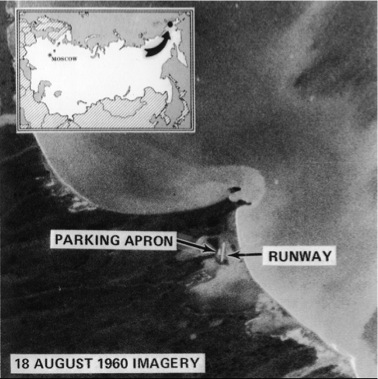
First satellite image from CORONA, the world’s first photo-reconnaissance satellite

Soviet First Secretary Nikita Khrushchev views wreckage of Powers’ U-2 aircraft
On 4 July, 1956, the first U-2 reconnaissance flight took place over the Soviet Union. The plane, flying at an altitude of nearly 70,000 feet, took high-resolution photographs of Soviet military installations around the city of Leningrad and the Soviet Northern Fleet bases around Severomorsk. For the first time the U.S. had precise insight into the Soviet military threat, but this insight came at a significant risk. Flying reconnaissance aircraft over another country’s airspace was tantamount to an act of war. Flying reconnaissance aircraft over the airspace of the ultra-paranoid Soviet Union was extremely dangerous, but President Eisenhower took the risk to gain insight into the missile and bomber threat posed by the Soviet Union.
Each U-2 flight had to be approved by President Eisenhower, and each time the CIA approached him with a flight request, Eisenhower would make the agency prove why the flight was needed. At the same time the U-2 flights were taking place, the Air Force and CIA were working on the world’s first photo-reconnaissance satellite. The satellite, called CORONA, would take pictures on film capsules, then eject the capsule over the Pacific Ocean, where an Air Force recovery plane would grab it in mid-air. There was some concern that orbiting a satellite over a country’s airspace might be the same as violating a country’s airspace with a U-2, but this concern was put to rest on 4 October, 1957, when the Soviet Union launched Sputnik, the world’s first satellite. Sputnik orbited the Earth by passing over the United States several times a day, giving the U.S. freedom to orbit a satellite over the Soviet Union.
U-2 flights were providing valuable intelligence on the Soviet military posture, but the flights could only cover small sectors of the world’s largest country. There were many bases, particularly ICBM bases, that remained outside the approved flight paths of the planes. The launching of Sputnik in 1957 added greater urgency for more missile base coverage, since placing a satellite in orbit required a missile with a significant amount of thrust, thrust which could in turn be used for more powerful ICBM’s aimed at the U.S. In 1960 President Eisenhower was scheduled to participate in a summit with Khruschchev, President DeGaulle of France, and Prime Minister Macmillan of the UK, with a subsequent trip to Moscow. Before these trips, however, CIA convinced Eisenhower that there was the need for one more U-2 flight. This flight, launched on 1 May, 1960, piloted by Francis Gary Powers, ended disastrously with the plane’s shoot down by a SAM over the Soviet city of Sverdlovsk. Powers was captured alive, imprisoned, and put on trial for espionage.
In one of history’s greatest ironies, on the date that Powers was convicted and sentenced to 10 years for spying for flying his U-2 over Soviet airspace, the first CORONA film capsule was recovered over the Pacific. On the roll of film was the world’s first satellite image from space. The image, of Mys Shmidta Air Field, which is 600 miles from Nome, Alaska, was incredibly crude by today’s standards, but it was one of the most significant intelligence feats in history. A satellite, orbiting without the knowledge of the target country, had provided intelligence on the target country without risking the life of a pilot, or incurring the threat of war. The first CORONA mission also covered far more territory on its one roll of film than all the U-2 flights that had taken place since 1956. A new era had begun. The CORONA satellite imagery also demonstrated that the so called “missile-gap” between the U.S. and the Soviet Union was decidedly to the advantage of the United States. The same was true of the bomber gap, and this intelligence had been gathered risk-free.
Sunday, August 15, 2010
15 August 1534-Ignatius Loyola Establishes the Society of Jesus

St. Ignatius of Loyola, as painted
by Rubens
Almost all European/Western Civilization history books cover the formation of the Society of Jesus, also known as the Jesuits, as this Roman Catholic priestly order had a profound effect on the spreading of both Catholic Christianity and Western European mores. The order was founded by Ignatius of Loyola on 15 August, 1534. 15 August is also the Feast of the Assumption, which is the day Roman Catholics celebrate as the day the Virgin Mary was bodily assumed into heaven, being spared the mortal pain of death.
Ignatius was born in Spain, and started his adult life as a solider. He participated in many battles, without suffering serious wounds, but on 21 May, 1520, his luck ran out. While fighting French forces in the Battle of Pamplona, a cannonball wounded one leg and severely broke the other. Ignatius required a long convalescence, and the leg had to be broken and re-set at least twice. During this time he read The LIfe of Christ by Ludolph of Saxony. This work, which was written in a style so that the reader experienced the events of the Gospels as though he were actually present at the time, had a profound effect on Loyola’s life. As he continued to heal, he read more religious works, which led a total re-dedication of his life. After his recovery from his wound, he spent several months in a cave near Catalonia, where he practices religious asceticism. When this period of prayer and study were over, he traveled to Palestine for three weeks in 1523, then returned to Spain. From Spain he journeyed to Paris, which at the time was a city in great upheaval due to battles between Catholics and Protestants. Martin Luther’s Reformation had reached France, and the clash of Protestant theology with Loyola’s fervent Catholicism spurred him to attend the University of Paris as a theology student.
While attending university, Loyola become close friends with the following individuals:
On 15 August, 1534, Loyola and his six companions met in the crypt of the Church of Our Lady of Montmartre, and pledged themselves to a life of poverty, chastity and obedience to the Pope as the newly created Society of Jesus. The primary mission of the order was to serve as the Pope’s missionaries, so the companions traveled to Rome to seek an audience with Pope Paul III. In 1537 Pope Paul III gave his blessing to the order and had the companions ordained as priests.
The Jesuits first set out to create schools and universities in Europe, as Loyola believed that the first step in arresting the Protestant Reformation was in educating the faithful. Loyola believed that one of the causes of the Protestant Reformation was an ill-informed, illiterate Catholic priesthood. Education would be his first bastion in re-claiming the world for the Catholic Church. Since he had started his life as a soldier, Loyola formed the Jesuits along military lines. The head of the order is called the Father-General, and there are rigid guidelines and steps before a man is ordained as a Jesuit priest. The Jesuit process, which is called formation, usually takes from 10-12 years, based on the applicant’s life experience. In addition to taking the normal priestly vows of poverty, chastity and obedience, a fully professed Jesuit swears a special fourth vow: obedience to the Pope and any missions he may request. Loyola’s creed for the Jesuit’s obedience to the Pope is eloquently stated here:
That we may be altogether of the same mind and in conformity with the Church herself, if she shall have defined anything to be black which appears to our eyes to be white, we ought in like manner to pronounce it to be black. For we must undoubtingly believe, that the Spirit of our Lord Jesus Christ, and the Spirit of the Orthodox Church His Spouse, by which Spirit we are governed and directed to Salvation, is the same.
As the Jesuits constructed schools and universities in Europe, they also engaged in counter-Reformation activities. Poland and Bohemia were already strong Protestant bastions, but Loyola’s Jesuits were so effective that they turned these territories into the Catholic strongholds that they are today. The Jesuits also began extensive missionary work in the Americas and Asia. Francis Xavier spread the Gospels to Japan and China, following the Jesuit model of focusing conversion on the rulers and other powerful figures. As European expansion spread in the Americas, Jesuit mission activities and school construction came along with the explorers. Today there are 28 Jesuit colleges and universities in the United States, an over 50 secondary schools. The order formed by St. Ignatius Loyola (he was canonized in 1622), had, and continues to have, a profound effect on civilization.
Sunday, August 1, 2010
1 August 1972-Senator Thomas Eagleton withdraws as Democratic VP Nominee
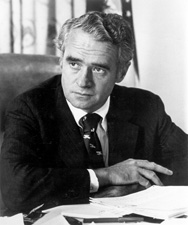
Senator Thomas Eagleton, D-Missouri
The 1972 Presidential campaign is mostly known for the Watergate break-in and Nixon’s landslide victory over Senator George McGovern, but one of the factors in that victory was the selection and removal of Senator Thomas Eagleton as McGovern’s running mate.
By the time the Democrats convened for their convention in Miami, President Nixon appeared unbeatable, with a double-digit lead over McGovern in almost all national polls. Polling showed that the only way McGovern had a chance to beat Nixon was by selecting Senator Edward Kennedy as his running mate. Despite the Chappaquiddick disaster in 1969, Kennedy was still immensely popular amongst the Democratic faithful, but Kennedy adamantly refused to be on the ticket. His refusal was echoed by other high profile Democrats such as Walter Mondale, Hubert Humphrey (who had served and been humiliated as Johnson’s VP, losing the 68 election to Nixon by a whisker), Edmund Muskie and Birch Bayh, all of whom could smell the landslide defeat coming to McGovern in November. McGovern decided to offer the slot to Thomas Eagleton, Senator from Missouri, even though he knew very little about Eagleton. This lack of knowledge would prove to be his undoing.
Eagleton accepted the nomination, and promised to bring his medical records with him to Miami for McGovern’s review, but he didn’t. He also failed to tell McGovern and the Democratic party leadership that he had checked into a hospital 3 times between 1960 and 1966 for mental and physical exhaustion, depression, and on at least one hospital stay he had been given electro-shock therapy. His use of Thorazine, a powerful anti-depressant medication was also not disclosed, but when it came up during the initial meeting with McGovern, Eagleton dismissed any concerns about the drug, stating that the prescriptions were in his wife’s name, not his. That subterfuge should have been a red flag for McGovern, but he did nothing about any concerns he had.
When McGovern got the medical records, he read that Eagleton suffered from “manic-depressive” and “suicidal tendencies”. McGovern then called two of Eagleton’s doctors, both of whom said they had “grave concerns” about Eagleton’s mental health. Now McGovern was in trap. On the public level, if he dropped Eagleton, the Republicans would pounce on his terrible decision making and lack of vetting. If he didn’t drop him, he would face tremendous pressure from rank and file Democrats, many of whom already didn’t like him and saw him as an enormous albatross taking the party towards a massive electoral defeat in November.
On a private level, McGovern worried about how his daughter Teresa would handle the announcement that he was dropping Eagleton because of his mental health problems. Teresa, like Eagleton, also suffered from depression, which would ultimately lead to her death in 1994. The editorial pages of The Washington Post and New York Times added fuel to the fire, when both papers said that Eagleton had to be dropped from the ticket, warning that a man with these problems could not be a heartbeat away from the Presidency.
McGovern initially said that he stood by Eagleton “1000%”, but pressure from party leaders continued to mount. Finally, McGovern made the decision to drop Eagleton, with Eagleton officially leaving the ticket on 1 August, 1972. Sargent Shriver, brother-in-law to Ted Kennedy, agreed to be the sacrificial lamb for the November slaughter, accepting McGovern’s offer of the VP nomination.
Later in life McGovern said he should have stuck by his initial decision to keep Eagleton, and he blamed his own ignorance of mental illness as the main reason for his decision to force Eagleton off the ticket. The selection of Eagleton and the cursory vetting showed just how much of the leadership of the Democratic party has passed out of the hands of the precinct captains and ward bosses and into the hands of the “people”, who proceeded to drive the party into a massive ditch. Nixon routed McGovern on 7 November 1972, carrying 49 states and 62% of the popular vote. McGovern carried Massachusetts and the District of Columbia. As the Watergate scandal erupted, I started seeing bumper stickers around my hometown of DC that read “Don’t blame me, I live in Massachusetts/DC”.
Eagleton went on with his Senate career, getting re-elected in 1974, 1980 and deciding not to run in 1986. After the Senate he was instrumental in brining the LA Rams to St. Louis. He died in 2007, and shortly after his death he was revealed as the source behind one of Robert Novak’s most explosive columns during the 1972 campaign. In May of 72 Novak published that “a Democratic senator says ‘people really don’t know McGovern. Once they get to know him, especially in the Midwest and heavily Catholic areas of the country, they’ll find out that he stands for amnesty, acid and abortion’” Amnesty, acid and abortion quickly became the smear Republicans used against McGovern, and when Novak was pressed to name his source, he approached Eagleton for permission to use his name. Eagleton refused, and Novak kept his secret until Eagleton died. There’s no doubt that McGovern would never have picked him as a running mate had he known the source of that quote.
Subscribe to:
Posts (Atom)